4. Conveying Ideas & Information
Introduction
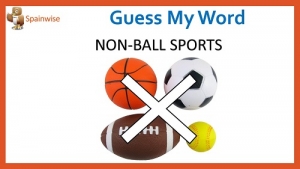
Each student has to think of a sport that does not use a ball. When they have a sport in mind they stand up but don’t say anything.
The teacher makes a guess. If it is a sport that a student is thinking, that student must sit down.
The teacher writes up a correct guess on the board under the heading Right and an incorrect guess under the heading Wrong.
When the teacher has guessed a sport correctly, any students sitting down now join in with the guessing. The teacher continues to record all the guesses in the relevant columns.
They continue in this way, with more and more students joining in guessing, until all the students are sitting down.
Defining
This is a great activity to get students using all four skills (reading, writing, listening and speaking) in English!
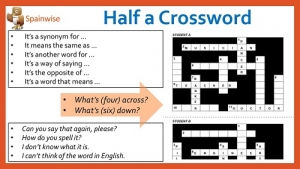
Students work in pairs (A and B). They each have a crossword with half of the words completed. However, A and B have different words.
The students take it in turns to ask for a word (e.g. What’s two across?) and their partner must give a definition (without saying the word!).
When a student guesses a word correctly they write it into their crossword.
They continue to take it in turns to ask for and give definitions until both students have completed their crosswords.
This activity can be easily adapted to any subject area that the students need to learn.
By having to define the words, the students are demonstrating that they truly understand them.
Describing
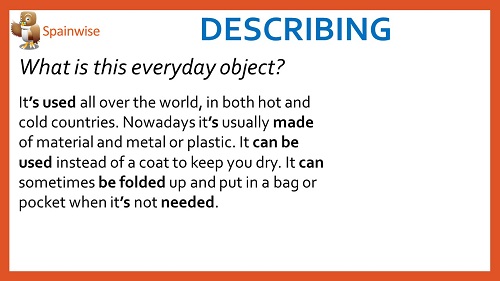
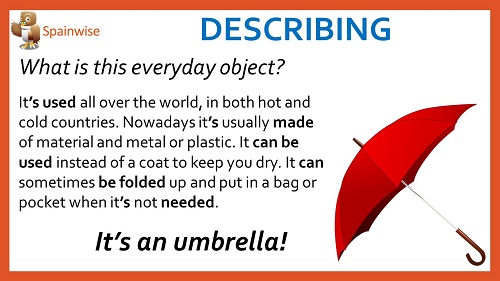
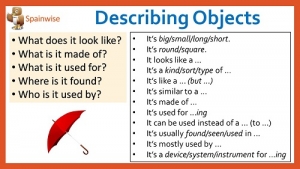
Both teachers and students need to be able to describe things in the classroom as well as subject-specific objects.
Being able to describe something when you don’t know the word for it is a valuable skill.
This ability gives students increased confidence when speaking English and greatly improves their fluency, as they won’t stop, panic or use Spanish every time they can’t remember or don’t know how to say something.
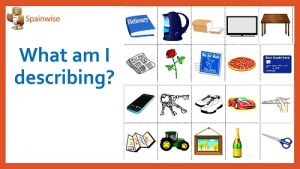
The pictures are printed out on papers.
Students work in small groups with the pile of papers in the middle.
Students take it in turns to take a paper (without showing the others) and describe the object.
The rest of the group has to guess what it is.
The teacher can help the students by giving them a set of useful expressions (scaffolding).
Once they’ve done this activity a few times, they will be able to remember and use the expressions more independently.
This activity is very adaptable for subject-specific language.
It can also be done by giving them words to use instead of pictures.
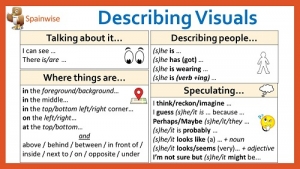
Students also need to learn to describe visual images, graphs and charts, etc.
The class is divided into two groups.
One student from each group sits at the front of the room with their back to the board.
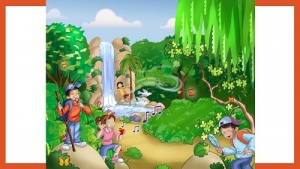
Each group has to describe the picture to their team member sitting at the front.
The students at the front have to listen and draw what is being described (preferably without the other students seeing what they draw).
When the picture has been described, the students who were drawing can turn around and compare their picture with the original on the board and then show the rest of the class.
It often helps to have a time limit.
This can be made into a competition for the best picture (i.e. the most similar to the original, the most accurate or the most details included).
It can also be done in smaller groups with more students drawing.
It can be adapted for other types of visual material, such as charts, graphs, mind maps, etc.).
Explaining
Focus on explaining activities, methods, procedures, processes, etc.
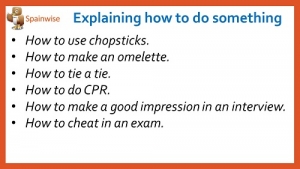
Teachers practise by explaining how to do a variety of ordinary things.
This could be made into a game with one person explaining something to another student or a group, while they have to guess what is being explained.
Remember the tips on giving instructions discussed in the last session.
Consider grading the language used, simplifying the explanations and clearly sequencing the steps of the activity.
Perhaps compare the different explanations given by the various pairs/groups and discuss which were most effective and why.