
Teaching Skills Input Session 4: Structuring a Lesson
The Basic Structure of a Lesson Plan
The basic structure of an English lesson plan usually includes the following parts:
Spainwise Lesson Plan Form
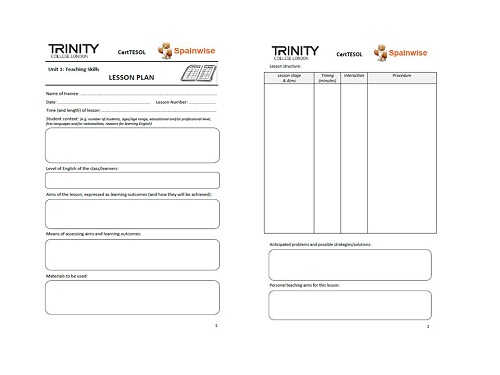
Click on the image above to download a pdf. version of the Spainwise Lesson Plan form.
Warmer

A warmer begins a lesson with energy and gets students excited to learn. Oftentimes warmers are a review of previously learned material, or they introduce what’s going to be covered in the lesson. Warmers should be short and motivational.
Presentation
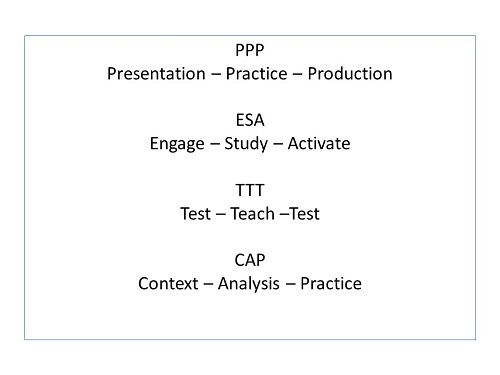
The presentation of a lesson generally introduces the topic, grammar points, vocabulary, and/or key expressions to be taught.

Practice

Here students begin to practice with the target language. This is a guided section of the class, one in which the role of the teacher is to give examples and monitor student responses
Production
The Production is perhaps the most important part of an ESL lesson to get the students producing the language practiced. At least one, but usually two student-centered activities should be done during the production segment of a class. The teacher should simply monitor students at this point, jumping in only to help with major mistakes or to clarify instructions.

Review

Having a review stage at the end of the lesson is extremely important too, as this is when students can often assimilate what they have learnt. Without the review stage, it’s easy to forget new information and knowledge.
Lesson Formats
Lesson Objectives: Test Case
Main Aim
By the end of the lesson, the learners will have improved their ability to introduce themselves to new acquaintances in both formal and informal situations.
Secondary Aim
Learners will become familiar with a range of fixed expressions used in introductions (e.g. Pleased to meet you; How’s it going?;etc)

Lesson Objectives: Task
Look at the following 10 activities, all of which might help in the achievement of the described lesson aims.
Which of them would you include in a 40 minute lesson and which would you reject?
Put them in the most logical order and remember to leave a few minutes for your lesson introduction and conclusion.

Learners watch several YouTube clips showing English speakers introducing themselves to one another in different situations. (5 mins)
Learners mingle around the class, introducing themselves to each other, first informally, then formally. The teacher monitors and offers support when necessary. (10 minutes)
The teacher explains/elicits the meaning of six key expressions used in formal and informal introductions. (6 minutes)
The teacher demonstrates a formal introduction with one learner and informal introduction with another. (3 minutes)
In pairs, learners practise reading out example introductory conversations while the teacher monitors and corrects pronunciation errors. (4 minutes)
The teacher drills the pronunciation of the most important expressions used in introductions; learners listen and repeat, first chorally (as a whole class) then individually. (3 minutes)
The teacher gives groups of learners two introductory conversations cut up on strips of paper. Learners must sort the strips into the two separate conversations an put them in the correct order. (5 minutes)
In small groups, learners discuss cultural differences between how people introduce themselves to one another in different countries. (5 minutes)
Working in pairs, learners write down an example introductory dialogue while the teacher monitors and corrects any mistakes in their texts. (5 minutes)
Two confident pairs of learners demonstrate formal and informal introductions in front of the class. (3 minutes)
Which of These 5 Teachers Do You Relate to Most?
“I never plan – I follow the coursebook. After all, it was written and trialled by experts.”
“I used to spend ages planning when I started teaching –but I’ve got more experienced so I feel I don’t need to.”
I plan … and plan and plan. I think I spend at least as much time planning as I do teaching. I do it because my students deserve a professional approach.
“I plan the first five minutes or so – just a speaking activity, something to get them going – and then I pick out some grammar, some vocabulary and go from there.”
“I would say I plan pretty carefully – but I hardly ever end up teaching the plan – you teach people, not plans, so you have to be prepared to adjust things according to what comes up.”


