
Teaching Skills Input Session 1: Welcome & Orientation
Introduction
Welcome to the Trinity Certificate in TESOL course run by Spainwise Teacher Training & Recruitment. This introduction is designed to give you important information you will need and to explain what will happen during the course. Over the course, you can expect to be extremely busy, though hopefully you will find it to be a productive and stimulating experience.
Trinity’s Cert TESOL Qualification
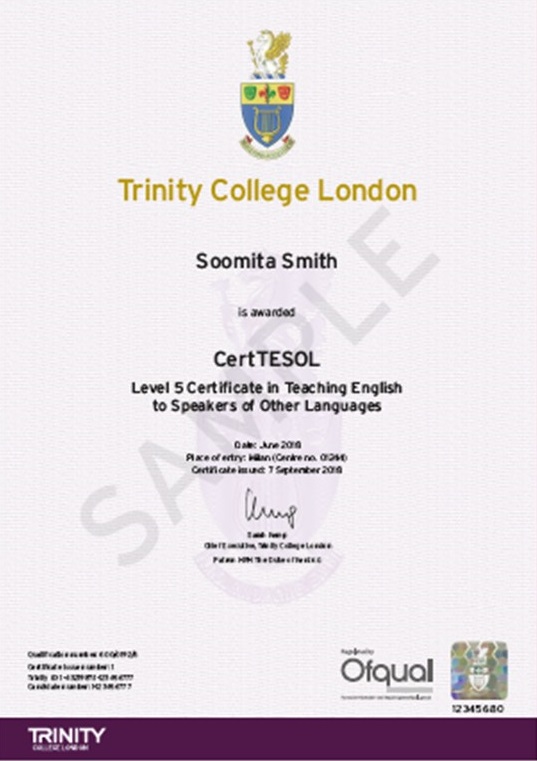
The Trinity Certificate in Teaching English to Speakers of Other Languages (CertTESOL) is a TESOL or TEFL (Teaching English as a Foreign Language) certificate designed for those with little or no experience of teaching English, and for those with experience who require an internationally recognised initial teacher education qualification.
It equips candidates with the basic skills and knowledge needed to take up a post as an ESOL teacher.
It gives an introduction to the theory and practice of English teaching and an insight into the challenges facing the learner and the role of the teacher.
The CertTESOL is accepted by the British Council as an initial TESOL or TEFL qualification for teachers in its accredited teaching organisations in the UK and in its own teaching operations overseas.
It is also widely recognised internationally by many other public and private organisations.
Course Content
The main course content is delivered and assessed through five units. The work for Units 1, 2, 3 and 5 is marked by your Spainwise course tutors and moderated or sampled and checked by a member of the Trinity moderators panel at the end of every course. The moderator externally assesses the work for Unit 4.
Professional awareness and development are ongoing themes. Successful trainees must demonstrate an awareness of the needs of other colleagues in the team, teaching and non-teaching, and the value of mutual support in the teaching, learning and training environment. They must also demonstrate an awareness of the need for professional development during and after the course, based on a constructive response to training input and feedback from tutors and peers.
The Units
Unit 1 Teaching Skills
Assessed through:
• Tutors’ evaluation of six hours of teaching with real learners
• A journal including trainees’ own lesson plans, with self- and tutor-evaluation
• A journal covering trainees’ reflective comments following observation of four hours of ESOL teaching by experienced teachers
Unit 2 Language Awareness including grammar and phonology
Assessed through:
• An end-of-course test (grammar, lexis and phonology)
• Ongoing use of spoken and written English
Unit 3 Learner Profile
Assessed through:
• The preparation of a simple linguistic profile and needs analysis, including some basic phoneme transcription, of a single learner
• The planning of, and reflection on, a one-to-one lesson
• The preparation of recommendations for the learner’s future development
Unit 4 Materials Assignment
Assessed through:
• Written rationale for the development of one piece of teaching material
• Written evaluation of use of this in classroom teaching
• Interview with a Trinity moderator to discuss the above and the ways in which materials development is beneficial to the development of teaching skills
Unit 5 Unknown Language
Assessed through:
• A journal covering trainees’ reflective comments on four hours’ tuition in an unknown language from the point of view of the beginner, including an analysis of the key aspects of methods and classroom management that affect the learner.
Procedures and Regulations
• We will be based in the Spainwise Training Room, although some sessions (including teaching practice sessions, unknown language classes and one-to-one teaching) may take place in rooms 1, 3, 4 and 5.
• The Training Room will be open between 9:15am and 2:30pm on Fridays.
• While this room is only for Spainwise tutors and trainees, please be careful about leaving valuable items such as mobiles and laptops unguarded as Spainwise cannot be held responsible for unattended personal items.
• The library and common room (next to the training room) will be open from 9:15am to 2:30pm on Fridays
• You are expected to attend all timetabled sessions on the course unless there are extenuating circumstances, agreed with trainers.
• Missing several sessions could result in the non-award of the Certificate.
• Spainwise is a non-smoking institution.
• It is very important that you adhere to the submission dates for all written assignments (see timetable) as it is very difficult to ‘catch up’ once you have fallen behind, and new tasks will be assigned repeatedly during the course.
• Late submissions are also liable for a reduction in the internal grade awarded.
• If you have problems with the pace of the course, please let the tutors know.
• In case of emergency, call the course manager (+ 34 692 623 687)
Course Schedule (4-week intensive course)
You can expect to be extremely busy over the four weeks of the course! However, the course has been designed to keep the input and tasks at a consistent level over the duration of the course and to avoid excessive workloads at any point.
In Week 1, the bulk of the input will be concerned with looking at methodologies, approaches to learning and teaching (Unit 1), as well as language awareness topics (Unit 2) – all in preparation for your first experiences of teaching on the course. You will also receive a set of four lessons in an Unknown Language (Unit 5) which will help you empathise with your own students and understand the problems they might face.
We will begin the Teaching Practice (Unit 1) on the Wednesday morning with everybody having an opportunity to teach three 10-minute slots before the weekend. You will also have observed two lessons with experienced teachers, one recorded, the other with a class you will be teaching yourself. You will also meet your learner for the 1:1 profile and begin the process of analyzing their language and skills level (Unit 3).
In Week 2, Teaching practice (Unit 1) will now form the basis of each day’s morning timetable. You can expect to be teaching almost every day. In input sessions, we will be looking more closely at skills development, teaching resources and classroom techniques (Unit 1). You will complete the last of the observations of experienced teachers and hand in the corresponding journal (Unit 1). There will also be daily input sessions on the Learner Profile (Unit 3) and Materials Assignment (Unit 4), as well as further work on Language Awareness (Unit 2).
In Week 3, you will have a tutorial with a course tutor at the beginning of the week to discuss your progress on the course and any concerns that you might have. Teaching Practice (Unit 1) will extend to longer periods and continue to be a major feature of the morning timetable. One of the main challenges this week will be the preparation for, and teaching of, one-to-one classes, as well as post-class journal work for the Learner Profile (Unit 3), traditionally considered to be the most extensive of the journals you must complete. In the input sessions, we will be doing further work on more comprehensive lesson planning and looking at wider issues such as preparing students for external assessment (Unit 1). The Language Awareness input sessions (Unit 2) will mainly focus on phonology.
In Week 4, Teaching Practice, feedback and the Teaching Practice Portfolio (Unit 1) will be completed on the Thursday. Similarly, we will finish preparation for the Language Awareness Test (Unit 2) to be held on the Wednesday. We’ll have the final input and planning sessions for the Materials Assignment and externally-moderated interview (Unit 4) which will take place on the last day of the course. In the input sessions we will be looking towards the future and considering contexts in which you might find yourself working, as well as discussing career opportunities.
Course Schedule (part-time course)
You can expect to be quite busy over the nine months of the course! However, the content of each term has been designed to keep the input and tasks at a consistent level and to avoid excessive workloads at any point.
In the first term, the bulk of the input will be concerned with looking at methodologies, approaches to learning and teaching skills (Unit 1), as well as language awareness topics (Unit 2). You will start lesson observation by watching a recorded lesson given by an experienced teacher. You will also receive a set of four lessons in an Unknown Language (Unit 5) which will help you empathise with your own students and understand the problems they might face. Towards the end of the term, we will start preparation for the Learner Profile (Unit 3), beginning with a linguistic analysis of Spanish speakers and an examination of the issues of cultural sensitivity and empathy. Similarly, we will have the first Materials Assignment (Unit 4) input sessions, comparing and analysing course books and resource books.
In the second term, we will be looking more closely at skills development, teaching resources and classroom techniques (Unit 1) and further work will be done on Language Awareness (Unit 2). However, significant work will also be done on the Learner Profile (Unit 3) with preparation for, and teaching of, one-to-one classes. Similarly, progress will be made with the Materials Assignment (Unit 4). You will observe lessons, with experienced teachers taking classes you will later teach yourself. You will also have to hand in the Guided Observation Journal (Unit 1). You will choose your learner for the 1:1 profile and begin the process of analyzing their language and skills level (Unit 3). In February, you will begin Teaching Practice (Unit 1), and this component will occupy a substantial part of your time until mid-May. You can expect to be teaching and/or observing others teach almost every week. During the second term, you will also have a tutorial with a course tutor to discuss your progress on the course and any concerns that you might have.
In the third term, teaching Practice (Unit 1) will continue to be a major feature of the timetable for the first half of the third term. Another feature of the third term is the post-class journal work for the Learner Profile (Unit 3), traditionally considered to be the most extensive of the journals you must complete. In the input sessions, we will be looking at how to use a variety of engaging classroom activities and teaching resources (Unit 1). There will be further Language Awareness sessions (Unit 2) to consolidate and review the language covered on the course.
Teaching Practice and feedback will come to an end and the Teaching Practice Portfolio (Unit 1) will be completed. Similarly, we will finish preparation for the Language Awareness Test (Unit 2) to be held towards the end of the course. We’ll have the final input and planning sessions for the Materials Assignment and externally-moderated interview (Unit 4) which will take place on the last day of the course. In the input sessions we will be looking towards the future and considering contexts in which you might find yourself working, as well as discussing career opportunities.


