
Introduction to Cambridge Exams
Cambridge English Exams are run by Cambridge Assessment English, which is part of the University of Cambridge. Their exams are accepted by over 20,000 organisations worldwide with the aim of providing the English language skills to communicate and succeed in the real world. Below are a few facts and figures about Cambridge Assessment English.
• Cambridge English Exams are recognised by over 20,000 universities.
• More than 5.5 million people take Cambridge qualifications and tests every year.
• Cambridge has over 2,800 exam centres in 130 countries.
• Over 50,000 preparation centres around the world prepare learners to take Cambridge exams.
• They have been providing English Language assessment since 1913.
Cambridge Exams are provided to a range of different ages and audiences including, early learners, school-age learners, general and higher education adults, and business English. Exams are provided at different levels of English proficiency related to the Common European Framework of Reference for Languages.
- Level
- Pre A1
- A1
- A2
- B1
- B2
- C1
- C2
- Schools
- Pre A1 Starters
- A1 Movers
- A2 Flyers / A2 Key for Schools
- B1 Preliminary for Schools
- B2 First for Schools
- C1 Advanced
- C2 Proficiency
- General & Higher Education
- –
- –
- A2 Key
- B1 Preliminary
- B2 First
- C1 Advanced
- C2 Proficiency
- Business
- –
- –
- –
- B1 Business Preliminary
- B2 Business Vantage
- C1 Business Higher
- –
Task 20.A
Choose the correct answers to complete the following sentences about Cambridge English Assessment’s exams.
Cambridge Exams in Spain
In Spain, the most common exams take place for levels A2 to C2 for schools and General and Higher Education. The following table provides an overview of what is included in each exam paper at each level.
| Level | Paper | Content | Time | Weighting |
|---|---|---|---|---|
| A2 (Key and Key for Schools) | Reading & Writing | 7 parts (32 questions) | 1 hour | 50% of total mark |
| Listening | 5 parts (25 questions) | 30 minutes approx. | 25% of total mark | |
| Speaking | 2 parts | 8-10 minutes per pair | 25% of total mark | |
| B1 (Preliminary and Preliminary for Schools) | Reading | 6 Parts (32 questions) | 45 minutes | 25% of total mark |
| Writing | 2 Parts (2 questions) | 45 minutes | 25% of total mark | |
| Listening | 4 parts (25 questions) | 30 minutes approx. | 25% of total mark | |
| Speaking | 4 parts | 12-17 minutes | 25% of total mark | |
| B2 (First and First for Schools) | Reading & Use of English | 7 parts (52 questions) | 1 hour 15 minutes | 40% of total mark |
| Writing | 2 parts (2 questions) | 1 hour 20 minutes | 20% of total mark | |
| Listening | 4 parts (30 questions) | 40 minutes approx. | 20% of total mark | |
| Speaking | 4 parts | 14 minutes per pair | 20% of total mark | |
| C1 (Advanced) | Reading & Use of English | 8 parts (56 questions) | 1 hour and 30 minutes | 40% of total mark |
| Writing | 2 parts | 1 hour and 30 minutes | 20% of total mark | |
| Listening | 4 parts (30 questions) | 40 minutes approx. | 20% of total mark | |
| Speaking | 4 parts | 15 minutes per pair | 20% of total mark | |
| C2 (Proficiency) | Reading & Use of English | 7 parts (53 questions) | 1 hour and 30 minutes | 40% of total mark |
| Writing | 2 parts (2 tasks) | 2 hours | 20% of total mark | |
| Listening | 4 parts (28 questions) | 40 minutes approx. | 20% of total mark | |
| Speaking | 3 parts | 16 minutes per pair | 20% of total mark | |
Task 20.B
Choose the correct answers to the following questions.
Cambridge Speaking Exam – Sample Video
Watch the video of a Cambridge English Speaking test and answer the questions below:
Task 20.C
Cambridge English IELTS
IELTS stands for International English Language Testing System. The results of these exams are used worldwide by governments for immigration purposes and by academic institutions, commercial organisations and many other professional bodies when processing applications.
Anybody can take the IELTS exam. It is not a “pass or fail” type of exam, the candidate is instead provided with a profile of their ability to use English. The results are given as “band” scores on a scale from 1 (the lowest) to 9 (the highest):
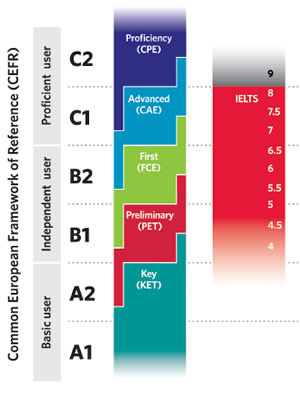
The diagram below shows how the IELTS scale aligns with other Cambridge Assessment levels and the Common European Framework of Reference for Languages.
Task 20.D
Choose the correct answer to the following question:


