
LAS Input Session 4: Working with Lexis
text
Refresh & Remember
Pre-Course Assignment Tasks 1-14

Language Assessment Input Session 1
Vocabulary Vs. Lexis
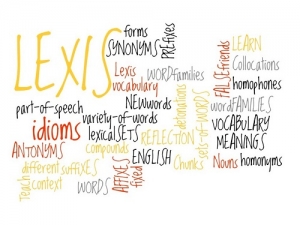
What’s the difference between vocabulary and lexis?
Vocabulary usually refers to individual words.
Lexis usually refers to ‘chunks’ of language .

Grammar Vs Lexis

Grammar is the glue holding everything together. It’s very important but on its own it’s rather pointless.
“Vocabulary is the Everest of language.”
“When students travel, they don’t carry grammar books, they carry dictionaries.”
“While without grammar very little can be conveyed, without vocabulary, nothing can be conveyed.”
Features of Lexis
Collocations
Idioms
Phrasal Verbs
Word Formation
Collocations
Key Questions
What is a collocation?
Collocations are wonderful chunks of language that native speakers of English use naturally and frequently. A collocation is two or more words that often go together. These combinations just sound “right” to native English speakers, who use them all the time. On the other hand, other combinations may be unnatural and just sound “wrong”.
Why are collocations important for teachers of English?
As teachers, it is our responsibility to show our students ways in which they not only understand meaning of these special language groupings, but ensure that they use them in the appropriate contexts.
Which of these sounds better?
“fast food” / “quick food”
Which of these is the strongest collocation?
“hard rain” / “heavy rain” / “strong rain”

“hard rain”, “heavy rain” or “strong rain”?
Types of Collocations
adjective + noun
a bright idea / heavy traffic / fierce rivalry
adverb + adjective
highly successful / completely useless / bitterly cold
adverb + verb
strongly suggest / barely see / distinctly remember
verb + adverb
wait patiently / live dangerously / rely heavily (on)
verb + noun
make a mistake / accept responsibility / tell the time
Working with Lexis: Task 1
Complete the collocations (1-10) with the missing words (a-j)
| 1. We were all very impressed by the student’s mental… | (a) ability |
| 2. My grandmother is very intelligent but she’s had little formal… | (b) agility |
| 3. I’ve never found it easy to learn scientific formulae by… | (c) education |
| 4. I’d love to study medicine there but it’s very hard to get a… | (d) heart |
| 5. For the first year Shakespeare exam we had to read six set… | (e) improvement |
| 6. I am so proud of you for managing to get full… | (f) learner |
| 7. Your work is not too bad but there is certainly still room for… | (g) marks |
| 8. Your little girl has shown herself to be a very quick… | (h) place |
| 9. The test has been designed to enable pupils to demonstrate their… | (i) requirements |
| 10. I hope to study there but I may not be able to meet the entry… | (j) texts |
Idioms
Key Questions
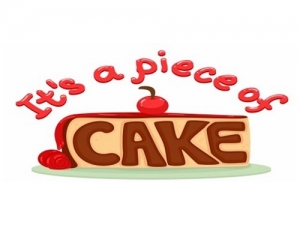
What does this expression mean?
It’s an idiom and means that something is really easy.
Idioms are colourful expressions whose meaning is different to the meaning of the individual words combined and cannot be taken literally.
Why might this expression be difficult for learners to understand and learn?
Learners may have difficulty guessing the meaning of idioms, which are often used by native speakers.
Idioms are quite difficult to learn as most of them are fixed expressions and the order of the words cannot be changed.
It‘s as easy as pie, isn’t it?
Not for everybody!
Working with Lexis: Task 2
Can you identify the idioms represented by these images?








Working with Lexis: Task 3
Which of the following idioms might be more useful for learners?
Which would be the most difficult to guess the meaning?
at the end of the day
not my cup of tea
the last straw
kick the bucket
Working with Lexis: Task 4
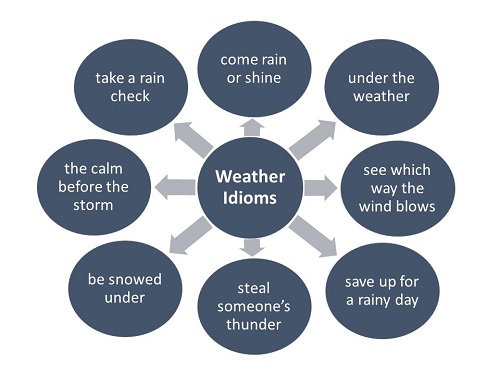
Watch this video about how to teach weather idioms.
How many of thee weather idioms can you use in a conversation?
Phrasal Verbs
Which of the following idioms might be more useful for learners?
| Verb | Definition | Example | |
|---|---|---|---|
| Single-Word Verb | look | direct your eyes in a certain direction | You must look before you leap. |
| Phrasal Verb (verb + adverb) | look up | search for and find information in a reference book | You can look up the word in a dictionary. |
| Phrasal Verb (verb + preposition) | look after | take care of | Who is looking after the baby? |
| Phrasal Verb (verb + adverb + preposition) | look forward to | anticípate with pleasure | I look forward to meeting you. |
Which of the following idioms might be more useful for learners?
When Rafa walked into his 5 o’clock lesson, it looked as if war had broken out! The kids were running around the classroom, and one of them, a big boy called Alberto, was running after Pepe, the class ‘clown’. Music was playing from the phone on Pilar’s desk so Rafa asked her to turn it off immediately. Then he stood in front of the class and told them all to be quiet. Gradually the noise died down. Rafa can do that: he has a natural teacher ‘presence’ and his students generally look up to him. But not Pepe, the boy Alberto had been chasing. Pepe took off, running out of the classroom and into the corridor. What should Rafa do? He couldn’t leave the class on their own. But at that moment another teacher walked past the door. Rafa asked her to look after the class while he set off to find Pepe.

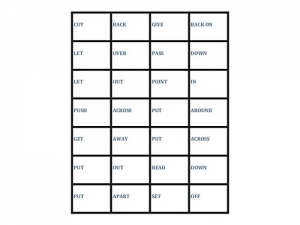
One way to practise phrasal verbs is with a dominoes game.

Word Formation
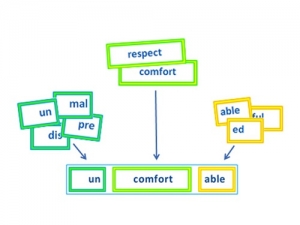
Key Questions
What is an affix?
An addition to the base form or stem of a word in order to modify its meaning or create a new word.
What is a prefix?
A prefix is a group of letters added to the beginning of a word, modifying the meaning of that word.
What is a suffix?
A suffix is a group of letters added to the end of a word, modifying the meaning of that word.
What is a morpheme?
A morpheme is the smallest unit of language to have meaning (e.g. -s, -ed)
Working with Lexis: Task 5
Read this story.
Beth is sitting in a quiet café having brunch. It’s the weekend so she had a lie-in today then got on her bike and came straight to the café.
Her mobile rings. She looks for it in her handbag (although her American friends often confuse her by calling it a purse), finds it and presses the green button with her long thumbnail. She lifts the phone to her ear. It’s Amy’s mum. Amy is a girl in Beth’s class.
At first, when Amy joined the class, Beth thought she was really intelligent, but as the weeks went by she began to suspect that perhaps she had overestimated her ability. And then, gradually, she became aware of the girl’s unhappiness.
She tried to find out what the problem was but it was impossible to get Amy to talk to her – at first. But in the end she found out that Chloe, another girl in the class, was the ringleader of a gang of girls who had been bullying Amy. Beth’s head teacher wanted to exclude Chloe, but Beth disagreed. She decided to work with Chloe, Amy and the rest of the class to sort out the problem… and now the situation has improved.
That’s why Amy’s mum has rung. She wants to say thank you.
How many affixes can you find in the story?
Find the word confuse in the story.
Here is the word family:
| Adjective | Adverb | Noun | Verb |
|---|---|---|---|
| confused confusing | confusingly | confusion | confuse |
Weekend is a compound noun.
Here are more compound nouns from the text:
handbag, ringleader, head teacher, thumbnail
Brunch is a blend or “portmanteau” word.
We can mix two words together to create a new blend.
Here are some more examples:
motel, spork and glamping
Teaching Lexis
C.A.P.

C: Context
A: Analysis
P: Practice
Clear contextualised example of target language
Provide students with a clear contextualised example (e.g. video clip, demonstration, image, written text, realia, listening) – this provides the context from which we can extract the language.
Focus on meaning, form and usage
Analyse the target language (what we want them to learn) – look at meaning (through definitions, examples, gestures, drawings, etc.), form (written form, pronunciation, part of speech, strong collocations), usage (appropriacy, frequency, formality).
Controlled practice followed by freer practice
Get students to practise the language themselves – first in a controlled practice so sts can check and consolidate their understanding and the teacher can also check understanding and correct any “conceptual” mistakes. Then freer practice offers students the opportunity to use the new language in a more natural or real-life type of situation (e.g. discussion or role-play)


